

How Many Shipping Container Mini Stores Does Starbucks Have?
Hundreds of Starbucks locations span the American landscape and dot the globe, many comprising standout architectural features or nods to local culture.

Hundreds of Starbucks locations span the American landscape and dot the globe, many comprising standout architectural features or nods to local culture. One sits mid-mountain in a California ski resort, one occupies the former site of the Berlin Wall, another tucks into Swiss train coaches roaming the tracks, and yet another features at least 2,000 oversized wooden sticks lining the walls and ceilings near a Japanese Shinto shrine. Unique as they are, nothing compares, at least in terms of the company's commitment to structural sustainability, to the growing collection of Starbucks mini-stores perched within former shipping containers.
The concept is nothing new, with a growing number of earth-conscious consumers choosing to park their lives within the confines of repurposed containers once holding goods shipped across oceans and continents. To date, Starbucks operates 40-plus stores within structures made at least partially from shipping containers, including 37 in the United States, according to a company spokesperson. They zigzag the country, making their homes in 20 states, including Washington, California, Oregon, New York, Pennsylvania, Hawaii, Connecticut, Texas, Georgia, and South Carolina. They also reside in international locations such as Taiwan, Peru, and the Dominican Republic, on the campus of the Universidad Iberoamericana (UNIBE) in Santo Domingo.
What makes these Starbucks stores stand out is the thoughtful designs but also the use of existing materials for construction. As opposed to virgin materials, the shipping container bases of the buildings, collectively, go a long way in reducing the environmental impacts of ongoing Starbucks expansion.
How The Shipping Container Versions Work

Starbucks Taiwan shipping-container store - Starbucks
Each shipping-container Starbucks store has its own story, some unknown but others with fascinating details and multiple journeys on the high seas. For example, the Starbucks store in Taiwan, nestled within Hualien Bay Mall, was designed by famed Japanese architect Kengo Kuma using 29 shipping containers placed strategically to invoke images of trees in an urban forest. The result is 3,444 square feet of space with skylights, vibrant wall art, and native totems, all invoking the colors and customs of the indigenous Ami people of Hualien. Port markings and notations on one of the containers indicate it passed through at least three global ports before transformation into a Starbucks shipping container store.
Shipping containers allow design flexibility for building blocks-like creativity, while also facilitating space conservation, minimizing landfill waste from typical construction, and reducing costs. In the United States, these Starbucks designs are generally built off-site, then delivered and installed on location. The first store to be constructed and assembled this way was in Starbucks' home territory of Washington State. The Tukwila store, less than 15 miles from Starbucks headquarters, was a drive-up modular structure dropped into place by construction cranes. Setting the standard for environmental responsibility, it adhered to LEEDS building certification standards.
This set things in motion for the company's expansion into modern modular structures and a rollout of dozens more shipping container sites. It also foreshadowed a major initiative known as the Starbucks Greener Stores Framework, which launched in 2018.
The Starbucks Greener Stores Framework
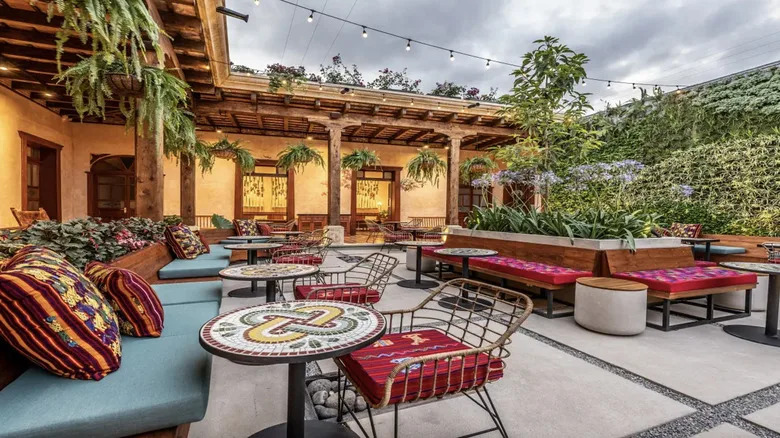
Starbucks Greener Store - Starbucks
With 2025 only a year away, Starbucks likely has the pedal to the metal on reaching its goal of constructing and operating 10,000 environmentally responsible Greener Stores around the globe. The formal name of the initiative, the Greener Stores Framework, works in conjunction with the World Wildlife Fund and SCS Global Services toward implementing a whopping 25 environmental impact standards. They include the given energy efficiency but also cover water and waste components.
All the target goals won't necessarily reach 100% compliance worldwide by 2024, but the company still holds out for a 50% reduction of landfill waste, carbon emissions, and water consumption in worldwide markets by 2030. While already seeing results of 30% in areas such as water savings and energy reduction in the United States, compared to standard store consumptions, it's saved Starbucks an estimated $60 million, noted the company spokesperson.
As far as the customer experience in Greener Stores, most changes in the 3,500 U.S. and Canadian locations already certified as Greener Stores are likely to go unnoticed. They include small tweaks covering things like energy-efficient water faucets, dishwashers, and signage, but also major projects such as water reclamation in Los Angeles. They encourage customer participation through programs like reusable cups and recycling coffee grounds for nourishing home gardens. As far as international progress, 88 stores in places like Vietnam, Argentina, and 16 other countries received certification by mid-2023.
About SCS Global Services
SCS Global Services is an international leader in third-party environmental and sustainability verification, certification, auditing, testing, and standards development. Its programs span a cross-section of industries, recognizing achievements in climate mitigation, green building, product manufacturing, food and agriculture, forestry, consumer products, and more. Headquartered in San Francisco, California and celebrating over 40 years in business, SCS Global Services has representatives and affiliate offices throughout the Americas, Asia/Pacific, Europe, and Africa. Its broad network of auditors are experts in their fields, and the company is a trusted partner to companies, agencies, and advocacy organizations due to its dedication to quality and professionalism. SCS Global Services is a chartered Benefit Corporation, reflecting its commitment to socially and environmentally responsible business practices. SCS Global Services is also a Participant of the United Nations Global Compact and adheres to its principles-based approach to responsible business. For more information, visit www.SCSGlobalServices.com.